Portrait Painting as Storytelling: Why I Paint People (and Why Women Have Become the Heart of My Work)
I still remember the first time I realised that portrait painting is not really about faces.
It happened years ago, in front of a canvas that was supposed to become a simple commission. The client had given me a photograph, a clear reference, good lighting, everything I needed. Technically, it should have been straightforward. But as I started working, something felt off. The proportions were right, the colours were accurate, the brushwork was clean .... yet the painting didn’t feel alive.
It looked like a person, but it didn’t feel like one.
And that moment stayed with me.
Because that is the strange truth about portrait painting: the closer you look, the more you realise how little a face is actually about appearance. A portrait is a presence. A portrait is a silent story. It is the trace of a life, of experiences, of emotions that have shaped someone over time.
That was the moment when portrait painting became more than a genre for me. It became a language.
Over the years, this theme has remained constant in my career as a professional artist. No matter how my style evolved, no matter what phase of my artistic life I was in, I always returned to portraits, to the human figure, to expression, to the quiet tension between what is visible and what is hidden.
Some people ask me why I don’t focus more on landscapes or abstract work, because it might be easier to sell. But I have never been interested in painting what is easy. I have always been drawn to what is real.
And nothing is more real than a human being.
When I create an oil portrait painting, whether it is a commissioned portrait or part of my free artistic practice, I often feel like I’m stepping into someone else’s world. Sometimes I meet the person I paint, sometimes I only know them through photographs and stories. But even then, I start noticing small details that are impossible to ignore: the way someone holds their shoulders, the tension in the jaw, the softness in the eyes, the quiet strength in a posture.
These details are never random.
They are the parts of us that we don’t always control, the parts that reveal who we are when we are not performing. And those are the moments I try to capture on canvas. Not the polished version of someone, not the perfect smile, but the essence. The personality. The human truth.
This is why oil painting is the medium I keep returning to.
Oil paint forces patience. It does not allow rushed decisions. It asks you to layer, to build depth, to slow down and observe. And in a world where everything has become fast, temporary and digital, there is something almost radical about painting an oil portrait on canvas. It is a commitment to permanence.


That is also why so many people are drawn to commissioned oil portraits today. Not because they need another image of themselves, we all have thousands of photos in our phones. But because a portrait painting becomes something different. It becomes part of a home. It becomes part of a family story. It becomes something that stays.
I have painted family portraits where the clients told me they wanted something timeless, something that their children could one day inherit. I have painted portraits as gifts, as celebrations, and sometimes as a way to hold on to someone who is no longer there. And every time, I feel the same responsibility: to create something honest.

A portrait should not just decorate a wall. It should carry meaning.
In recent years, my free work has become increasingly focused on women.
This was not something I planned. It happened naturally, almost like a quiet shift that grew stronger with every new canvas. The more I painted, the more I felt drawn to female portraits, not in a romantic or idealised way, but in a deeply human one.
For centuries, women have been present in painting, but rarely as true individuals. They were often painted as muses, as symbols, as objects of beauty, as figures meant to represent an idea rather than a life. Even today, the art world still reflects that imbalance. Museums still show far more works by male artists, and women are still too often reduced to a role rather than portrayed in their complexity.
I find myself wanting to respond to that with paint.
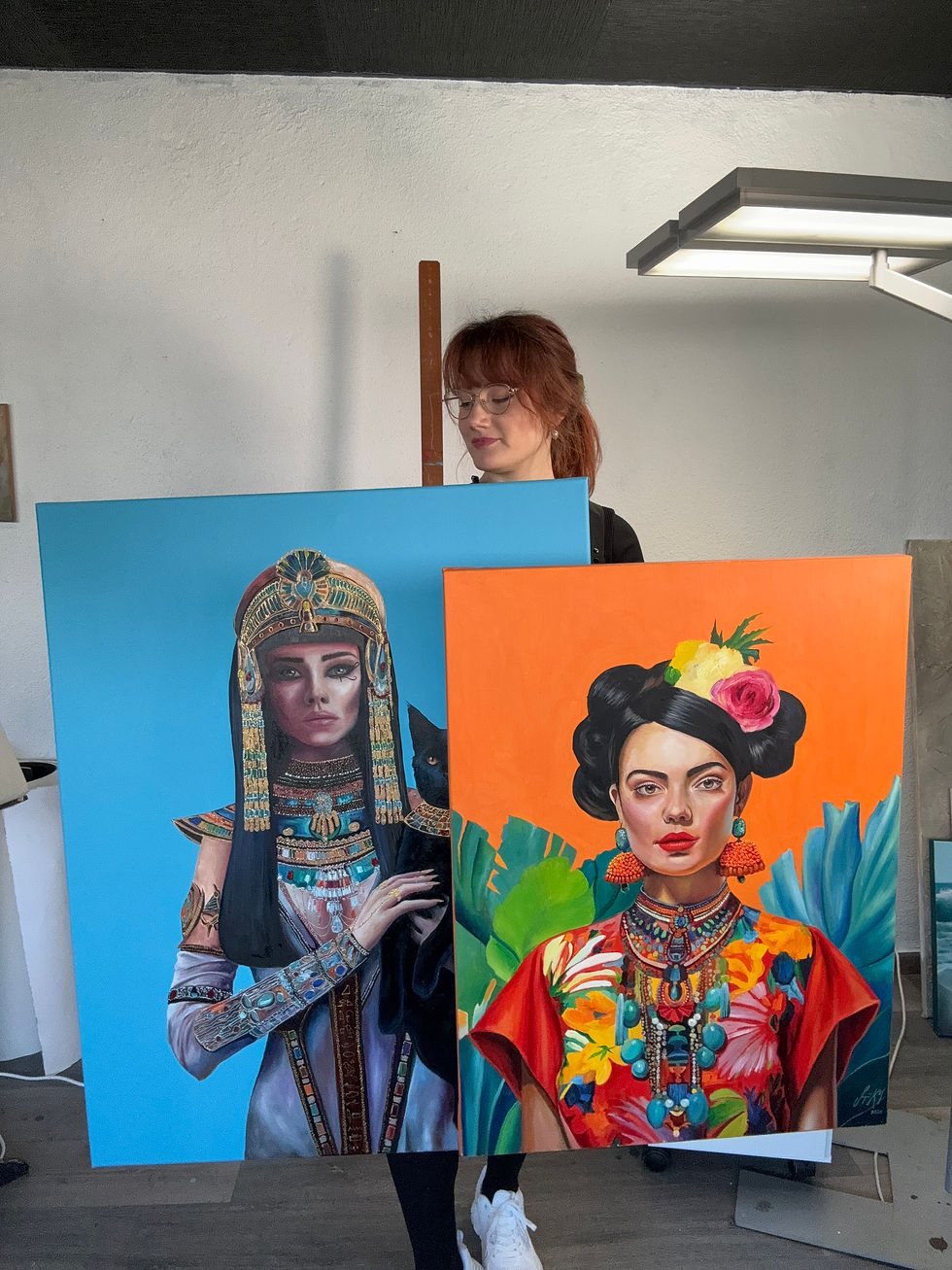
Not by making a loud statement, but by creating images that quietly redefine how women are seen. I paint women as subjects, not as decoration. I paint them as personalities, strong, tired, sensual, distant, present, soft, bold, complicated. Sometimes calm, sometimes confronting. Sometimes vulnerable, sometimes untouchable.
Because women are not one story. They are many.
And perhaps that is what I love most about portrait painting: it refuses simplification.
A portrait forces you to look again. It asks the viewer to stay with the person in the painting longer than they would in real life. It makes space for emotion. It makes space for silence. It creates a connection between strangers.

And in that connection, something happens. Something subtle but powerful.
That is why I believe portrait painting still matters today. Not as a tradition, but as a necessity. In a world that moves quickly and forgets quickly, a portrait reminds us that a human life is not something to scroll past.
It is something to witness.
Throughout the entire month of March, my newest works will be exhibited at the Birsfelder Museum. This collection includes some of my latest explorations of portrait painting and the female figure on canvas, paintings that reflect the themes that have shaped my artistic journey for years, and that continue to evolve with every brushstroke.
Seeing a portrait in real life is different than seeing it online. The texture, the layers, the depth of oil paint, all the things that make the painting breathe, can only truly be experienced in front of the canvas.
I recently started writing more about these thoughts, and about the stories behind my newest works, on my website. Because I realised that people often want to know more than just the final image. They want to understand what inspired the painting, what the process looked like, and what the work means beyond what is visible.
If you are curious, you can read more in my blog on my website.
And if you’ve ever wondered what a painted portrait can capture that a photograph cannot, then you might enjoy what I will share next. Because the truth is: the most important part of a portrait is often the part you can’t immediately explain.
But you can feel it.
And once you feel it, you start seeing portraits and people ... differently.
Your Artist
Stephanie


Comments